
数学与生命科学交叉研究中心
中心简介
团队负责人:原三领 教授
数学与生命科学交叉研究中心在原三领教授带领下,以气候变化影响下的海洋生态系统研究为基础,研究海洋生态过程、生物多样性响应与资源可持续利用,并将数学建模、统计推断与机器学习融入观测、计算与实验分析,为全球生态环境问题提供科学依据与解决方案。
主要研究领域:微分方程稳定性与分支理论、随机微分方程理论、海洋生态动力学、种群动力学、生态化学计量学、恒化器动力学。
研究方向
方向一随机种群动力学研究生态预警、生态保护区与生态修复
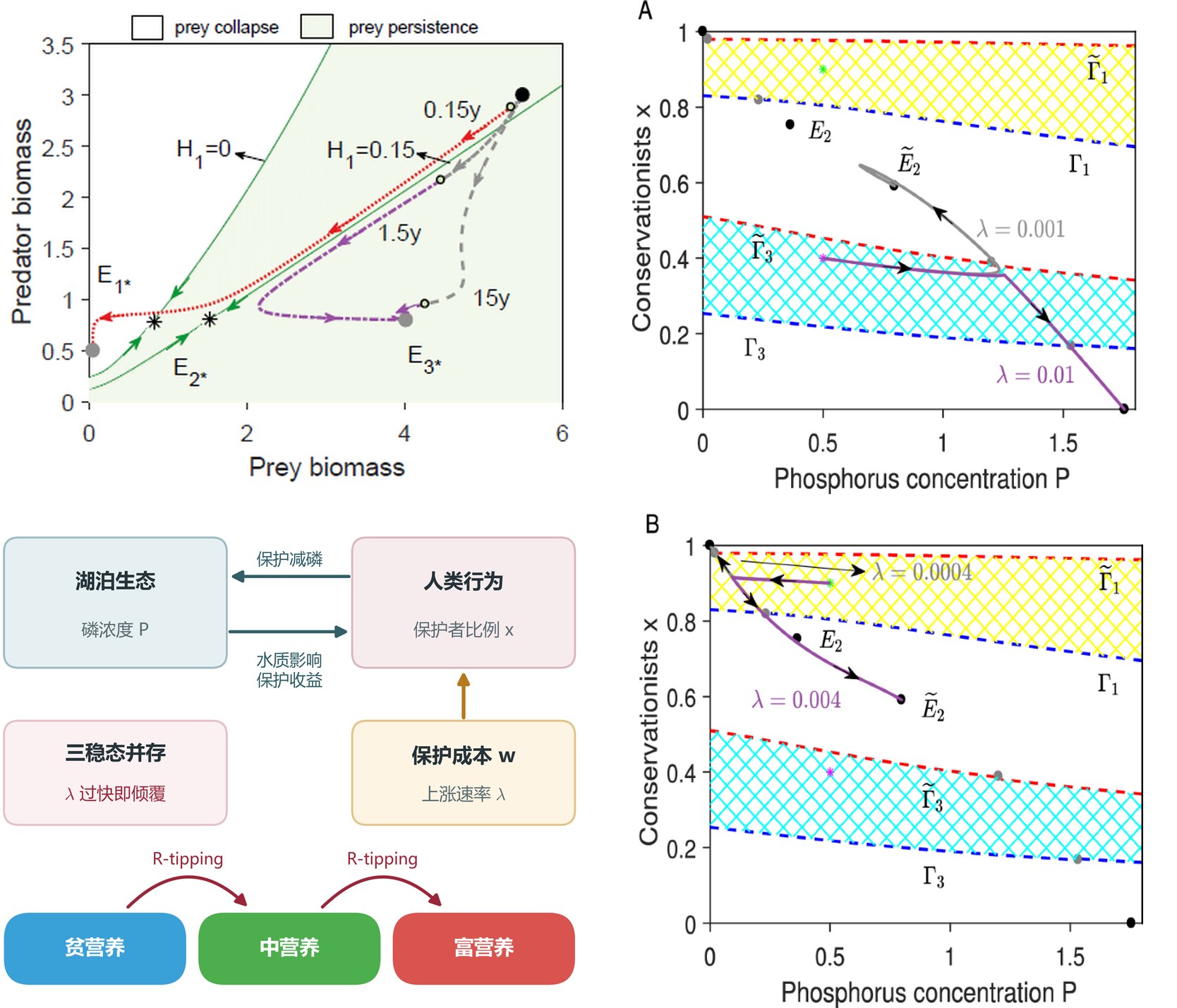
在随机环境下研究渔业生态与市场、湖泊营养状态与人类保护行为等耦合系统:用复制子动力学刻画保护决策并与生态子系统耦合,分析多稳态、周期振荡与临界转变,为生态预警与修复提供依据。[1]

保护成本上涨过快会触发速率诱导倾覆:上涨速率超过阈值 λ* 后,中营养→富营养的倾覆概率反超贫营养→中营养,湖泊更易滑向富营养。启示:只限制保护成本的大小不足以遏制湖泊恶化,还须控制其上涨速度。
变量说明
λ:保护成本 w 的上涨速率;λ*:速率阈值;ℙ(·):发生相应倾覆的概率;E01、Ẽ2、E30:贫营养、中营养、富营养稳态。按论文摘要结论与 Fig. 8 记号整理,不是原文编号公式。
方向二结构种群模型、多尺度耦合系统动力学、适应动力学
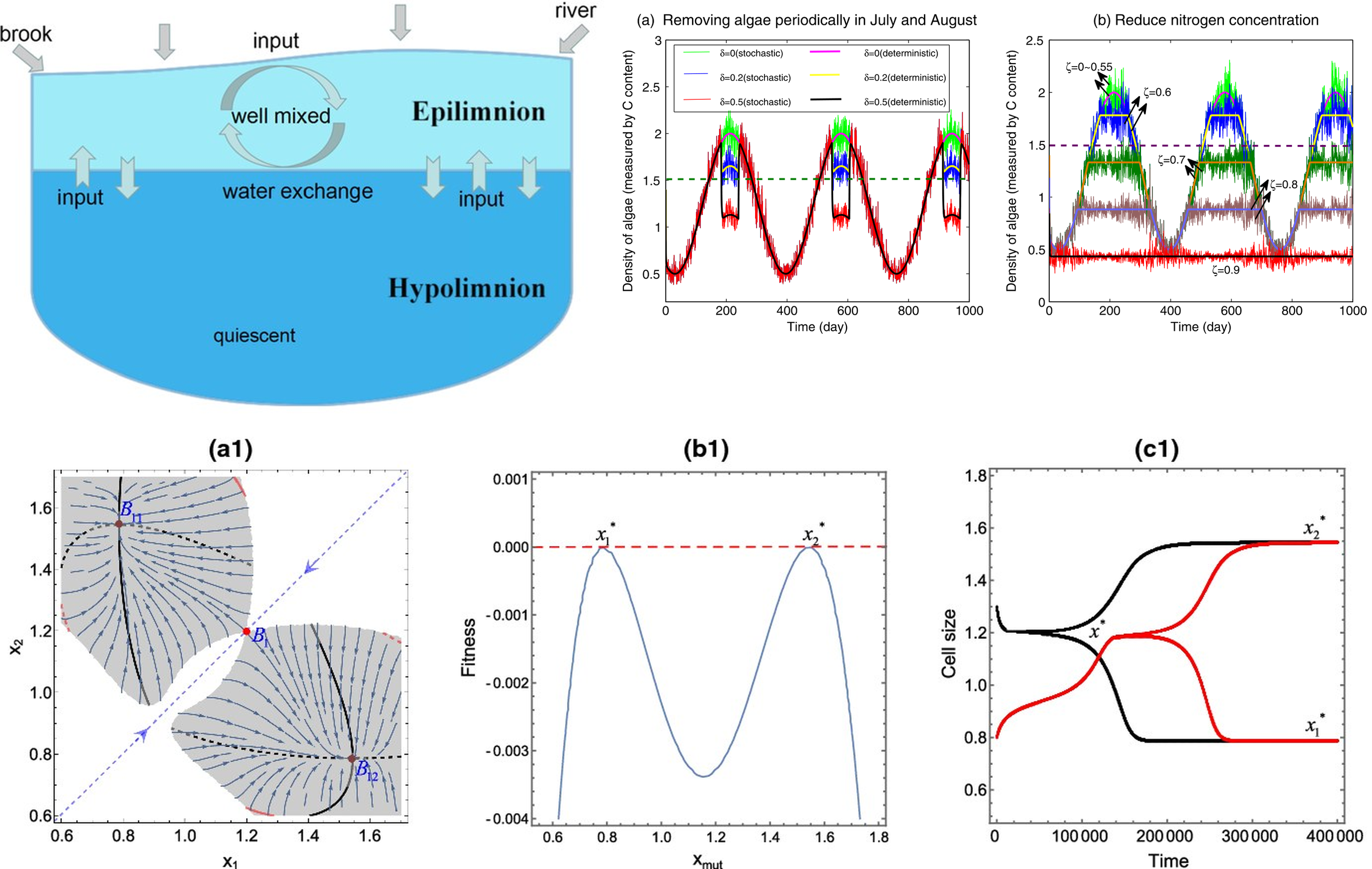
从微观环境、细胞摄食率到多营养级耦合,以细胞大小等性状为结构变量,标定水生生态物种的演化指标,借助种群生存阈值揭示其适应性演化。[2]

入侵适应度对突变性状的二阶导数为负:奇异性状 xi* 处局部进化稳定,种群可分化为两种细胞大小并长期共存。
变量说明
F:突变体入侵适应度;x1, x2:两类藻的细胞大小性状;xmut:突变性状;h2i:原文定义的组合量。原文附录式 (E.88),节选。
方向三反应扩散捕食食饵系统的分支与斑图动力学
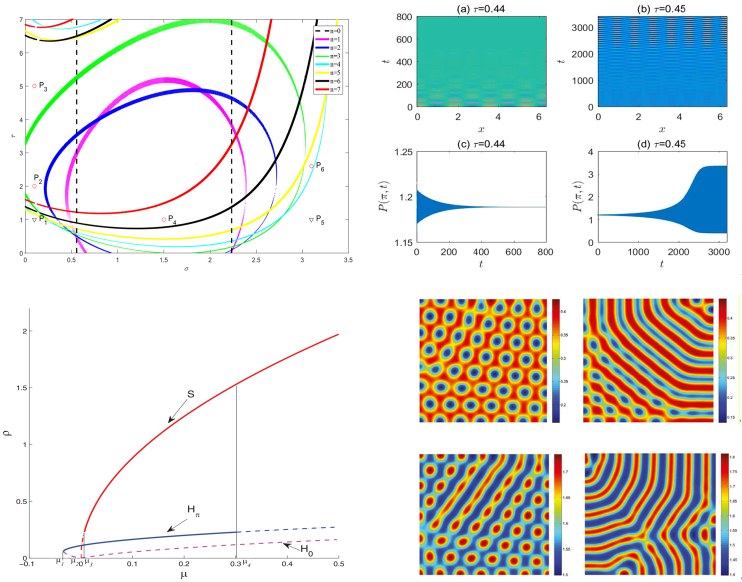
以生态机制驱动的反应扩散捕食—食饵系统为对象,运用稳定性切换曲线、正规形与振幅方程,揭示稳定性切换与斑图形成条件,拓展生态种群时空斑图涌现的新机制。[3]

成熟时滞 σ 与记忆时滞 τ 穿越 (σ, τ) 平面上的稳定性切换曲线时发生 Hopf 分支;由正规形确定分支方向与周期解稳定性,系统可出现多次稳定性切换,并产生稳定的空间非均匀(mode-4)周期解。
变量说明
N, P:猎物 / 成年捕食者密度;δ11、δ22:随机扩散系数;δ12:猎物的记忆型扩散系数;τ:猎物平均记忆时长;σ:捕食者成熟时滞,Nσ = N(t − σ)、Pσ = P(t − σ);h:捕食者 Allee 效应强度;d:幼体死亡率。原文式 (2),略去 Neumann 边界条件。
方向四基于数据驱动的海洋生态系统动力学建模与研究
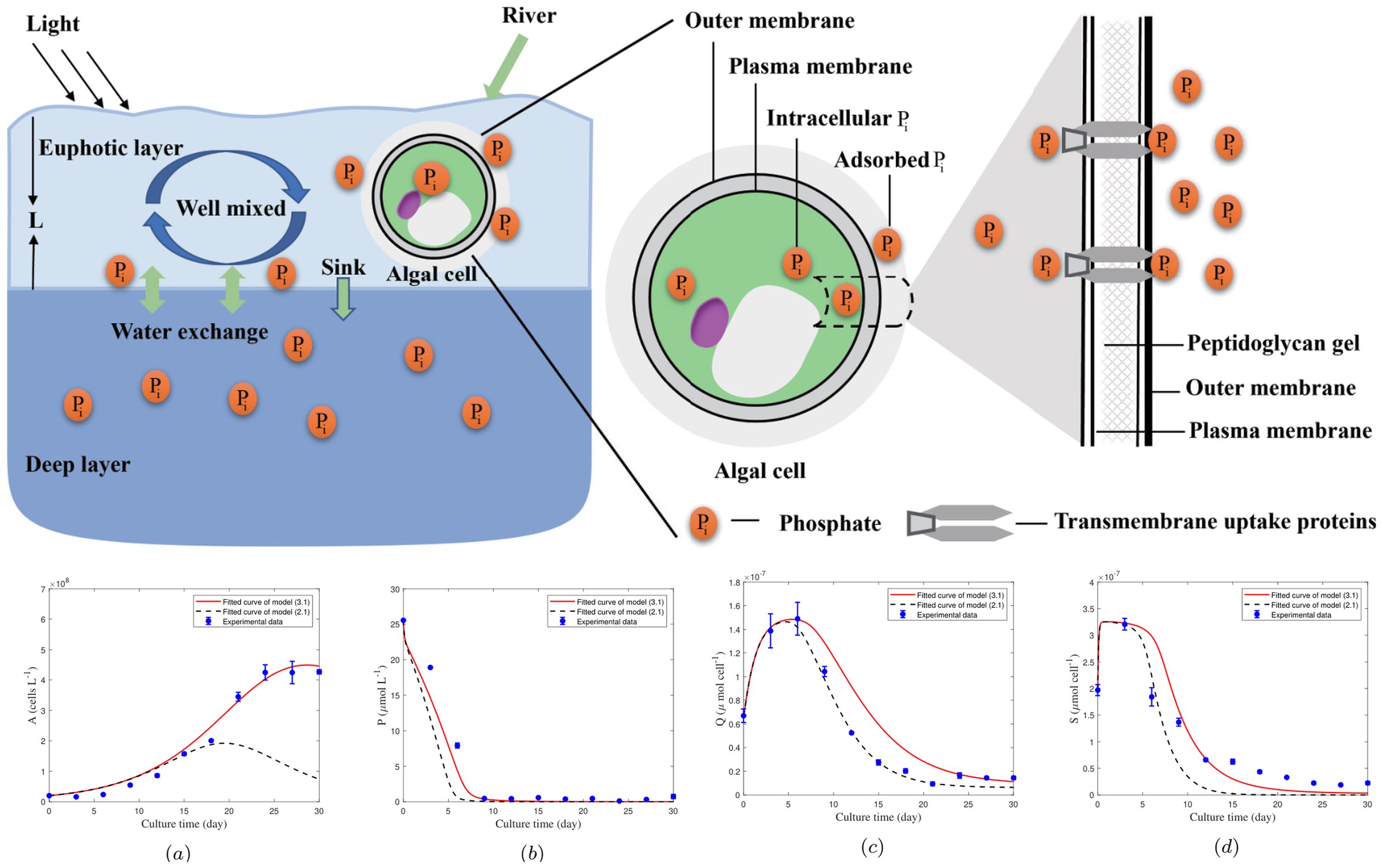
建立具有两阶段磷吸收过程和化学计量约束的藻类增长模型,将模型分析、数据分析与算法相结合,估计有害藻华的持续时间,为藻华预警与防治提供理论依据。[4]
磷先吸附于细胞表面(S)再转入胞内(Q),胞内磷配额决定增长率 μ;由此刻画高速向低速生长的切换并估计藻华持续时间。
变量说明
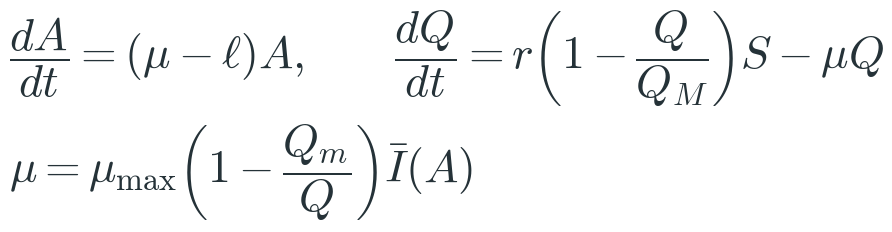
A:藻细胞密度;Q / S:胞内 / 表面磷配额;μ:增长率;ℓ:总损失率;Ī:光限制因子。四维模型节选,按作者预印本式 (2.1) 简写。
代表文献
Anji Yang, Hao Wang, Sanling Yuan. Rate-induced tipping in a lake eutrophication model coupled with human activities. Journal of Mathematical Biology, 2026, 92(4): 52. DOI: 10.1007/s00285-026-02381-7
Shengnan Zhao, Sanling Yuan, Hao Wang. Adaptive dynamics of a stoichiometric phosphorus–algae–zooplankton model with environmental fluctuations. Journal of Nonlinear Science, 2022, 32(3): 36. DOI: 10.1007/s00332-022-09794-w
Shuai Li, Sanling Yuan, Zhen Jin, Hao Wang. Bifurcation analysis in a diffusive predator-prey model with spatial memory of prey, Allee effect and maturation delay of predator. Journal of Differential Equations, 2023, 357: 32–63. DOI: 10.1016/j.jde.2023.02.009
Shufei Gao, Sanling Yuan, Anglu Shen, Hao Wang. Asymptotic and transient dynamics of a stoichiometric algal growth model with two-stage phosphate uptake. SIAM Journal on Applied Mathematics, 2024, 84(4): 1668–1696. DOI: 10.1137/23M1611750
其他文献
Anji Yang, Sanling Yuan, Yun Kang. Fast anthropogenic environmental change can cause the collapse of fishery ecosystems. SIAM Journal on Applied Mathematics, 2025, 85(5): 2242–2268. DOI: 10.1137/24M1693052
Chenxia Zhao, Anji Yang, Tonghua Zhang, Sanling Yuan. Dynamics analysis of a coupled fishery-economic model with environmental fluctuations. Chaos, Solitons & Fractals, 2025, 195: 116242. DOI: 10.1016/j.chaos.2025.116242
Anji Yang, Sanling Yuan, Tonghua Zhang. Environmental stochasticity driving the extinction of top predators in a food chain chemostat model. Journal of Nonlinear Science, 2024, 34(3): 50. DOI: 10.1007/s00332-024-10026-6
Anji Yang, Hao Wang, Sanling Yuan. Tipping time in a stochastic Leslie predator-prey model. Chaos, Solitons & Fractals, 2023, 171: 113439. DOI: 10.1016/j.chaos.2023.113439
Tingting Yu, Sanling Yuan. Dynamic analysis of a stage-structured forest population model with non-smooth continuous threshold harvesting. Applied Mathematical Modelling, 2023, 120: 1–24. DOI: 10.1016/j.apm.2023.03.026
Xi-Chao Duan, Sanling Yuan, Maia Martcheva. Habitat adaption promotes the evolution of predator species. Zeitschrift für angewandte Mathematik und Physik, 2023, 74(1): 10. DOI: 10.1007/s00033-022-01904-8
Anglu Shen, Shufei Gao, Jie Jiang, Qingjing Hu, Hao Wang, Sanling Yuan. Oscillations of algal cell quota: Considering two-stage phosphate uptake kinetics. Journal of Theoretical Biology, 2024, 581: 111739. DOI: 10.1016/j.jtbi.2024.111739
Cuihua Wang, Sanling Yuan, Hao Wang. Spatiotemporal patterns of a diffusive prey-predator model with spatial memory and pregnancy period in an intimidatory environment. Journal of Mathematical Biology, 2022, 84(3): 12. DOI: 10.1007/s00285-022-01716-4
Shuai Li, Sanling Yuan, Zhen Jin, Hao Wang. Double Hopf bifurcation induced by spatial memory in a diffusive predator-prey model with Allee effect and maturation delay of predator. Communications in Nonlinear Science and Numerical Simulation, 2024, 132: 107936. DOI: 10.1016/j.cnsns.2024.107936
Jingen Yang, Tonghua Zhang, Sanling Yuan. Turing pattern induced by cross-diffusion in a predator-prey model with pack predation-herd behavior. International Journal of Bifurcation and Chaos, 2020, 30(7): 2050103. DOI: 10.1142/S0218127420501035
Shuixian Yan, Dongxue Jia, Tonghua Zhang, Sanling Yuan. Pattern dynamics in a diffusive predator-prey model with hunting cooperations. Chaos, Solitons & Fractals, 2020, 130: 109428. DOI: 10.1016/j.chaos.2019.109428
Qiang Li, Zhijun Liu, Sanling Yuan. Cross-diffusion induced Turing instability for a competition model with saturation effect. Applied Mathematics and Computation, 2019, 347: 64–77. DOI: 10.1016/j.amc.2018.10.071
Shengnan Zhao, Sanling Yuan, Hao Wang. Threshold behavior in a stochastic algal growth model with stoichiometric constraints and seasonal variation. Journal of Differential Equations, 2020, 268: 5113–5139. DOI: 10.1016/j.jde.2019.11.004
图中曲线、坐标与图例均取自原论文图版;方程为原文节选。更多成果见 中心官网论文成果。
